
What is actually growing on your roof, and what to do about it
Most people call us describing an appearance rather than a cause: green, black streaks, crusty patches, or water coming over the gutter. Each of those has a different organism or mechanism behind it, and each needs a different response.
These pages explain what you are looking at from the ground, why it is happening on your roof and not your neighbour's, and what the honest fix is.
Diagnose it from the ground
Match what you can see to the page that explains it.
- Black streaks running down your roof tilesCommon problem
- Crusty lichen on roof tiles and why it is harder to shift than mossCommon problem
- Why the north-facing slope is always the one covered in mossCommon problem
- Moss is blocking your guttersCommon problem
- Slate roofsRoof covering
- Clay peg, plain and pantile roofs cleaned without breaking nibsRoof covering
- uPVC fascias and soffitsCommon problem
- Moss in valleys and along the ridgeCommon problem
- Chimney stacks and flashingCommon problem
- Overflowing gutters usually mean the downpipe, not the gutterCommon problem
- The little tree growing out of your gutter is more urgent than it looksCommon problem
- Roof moss around solar panels needs a different plan, not a bigger brushCommon problem
- Roofs under tree coverCommon problem
- Moss keeps falling off my roof into the gardenProblem
- Why your gutters are sagging and pooling waterProblem
- Nesting material in gutters and under roof edgesProblem
- Damp patch upstairsProblem
Quick identification
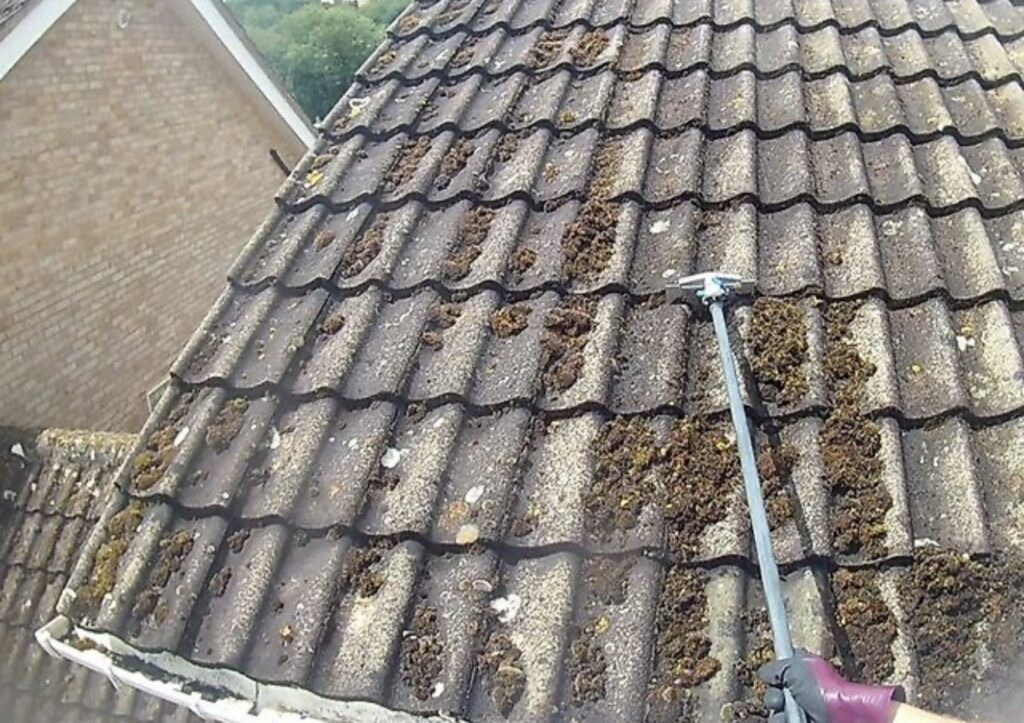
Soft green cushions, thickest at the eaves and in valleys — moss.
Flat, crusty grey, white or orange patches that look painted on — lichen.
Dark vertical streaks running down from the ridge — algae.
Water spilling over the gutter front edge in heavy rain — blocked run or downpipe.
Why the same roof problem behaves differently house to house
Two identical houses on opposite sides of the same street can be in completely different condition, and it is almost always down to three variables: which way the main pitches face, what is growing next to the building, and what colour the tiles are.
Aspect decides how long the covering stays wet after rain. Tree cover decides how much organic debris and shade the roof gets. Tile colour decides how early you notice any of it. None of those are faults, which is why the honest answer to "is something wrong with my roof?" is usually no.
Working out what you are looking at
- Step 1
Look at the texture
Three-dimensional and soft is moss. Flat and crusty is lichen. Flat and smooth is algae film.
- Step 2
Look at the pattern
Vertical streaks from the ridge are algae. Concentration at eaves and valleys is moss.
- Step 3
Look at the aspect
If it is worse on one slope, note which way that slope faces before you call anyone.
- Step 4
Check in heavy rain
Overflow at the gutter edge during a downpour points at a blocked run or downpipe rather than a roof problem.
One thing that applies to all of them
None of these problems is solved by pressure washing. Force removes the visible growth, strips the weathered tile surface underneath and leaves a rougher, more porous face that recolonises faster than before. Every page here recommends hand work and low-pressure treatment for the same reason.
Questions we get asked
How do I tell moss from lichen?
Moss is soft, green and three-dimensional, and lifts off in mats. Lichen is flat, crusty and bonded to the tile — it looks painted on and will not lift.
Is any of this actually damaging my roof?
Thick moss is, because it holds water against the tiles and blocks drainage. Algae and lichen are mainly cosmetic, though lichen is much harder to remove cleanly.
Why is my roof worse than my neighbour's?
Aspect, tree cover and tile colour. A north-facing pitch under trees will always be worse than a south-facing one across the road.
Can I treat it myself from the ground?
Ground-applied products exist but they rarely reach the ridge or the overlaps where the problem lives, and climbing a roof to do it properly is where people get hurt.
Send a photo and we will identify it
A single picture from the driveway is usually enough for us to tell you what is growing and whether it needs doing this year.
Sky Scrapers Ltd · info@sky-scrapers.co.uk
Diagnosis first
Identify the organism, then choose the method. Moss needs lifting, lichen needs treating, algae needs biocide, and blocked gutters need the roof above them sorted too.