
Black streaks running down your roof tiles — what they actually are
Dark vertical streaking down a roof is one of the most common things people call us about, and it is almost always misdiagnosed as dirt, pollution or 'the tiles wearing out'.
It is biological. The streaks are colonies of airborne algae that establish on the tile surface and spread downwards with the run-off, which is why they always run vertically and always start at the ridge.
Why it looks the way it does
Algae land on the roof as airborne spores, take hold where moisture lingers, and then spread down the pitch every time it rains as the run-off carries cells with it. That is why the streaking is directional, why it is worse below ridge and hip lines, and why it appears on some slopes and not others on the same house.
Pale tile ranges show it earliest because of the contrast. Dark tiles carry exactly the same colonisation and just conceal it for longer.
Why scrubbing and pressure make it worse
- Pressure washing strips the weathered surface off concrete tiles, leaving a rougher, more porous face that re-colonises faster.
- Mechanical cleaning removes the visible cells but not the spore load, so the streaks return within a season or two.
- Force drives water under laps and into the roof space, which is a far worse problem than staining.
What actually works
Killing the organism rather than removing the stain. A low-pressure softwash with biocide treats the whole covering, including the areas that still look clean but carry the spore load that would reseed the rest. The roof then keeps lightening for weeks afterwards as the dead growth weathers off.
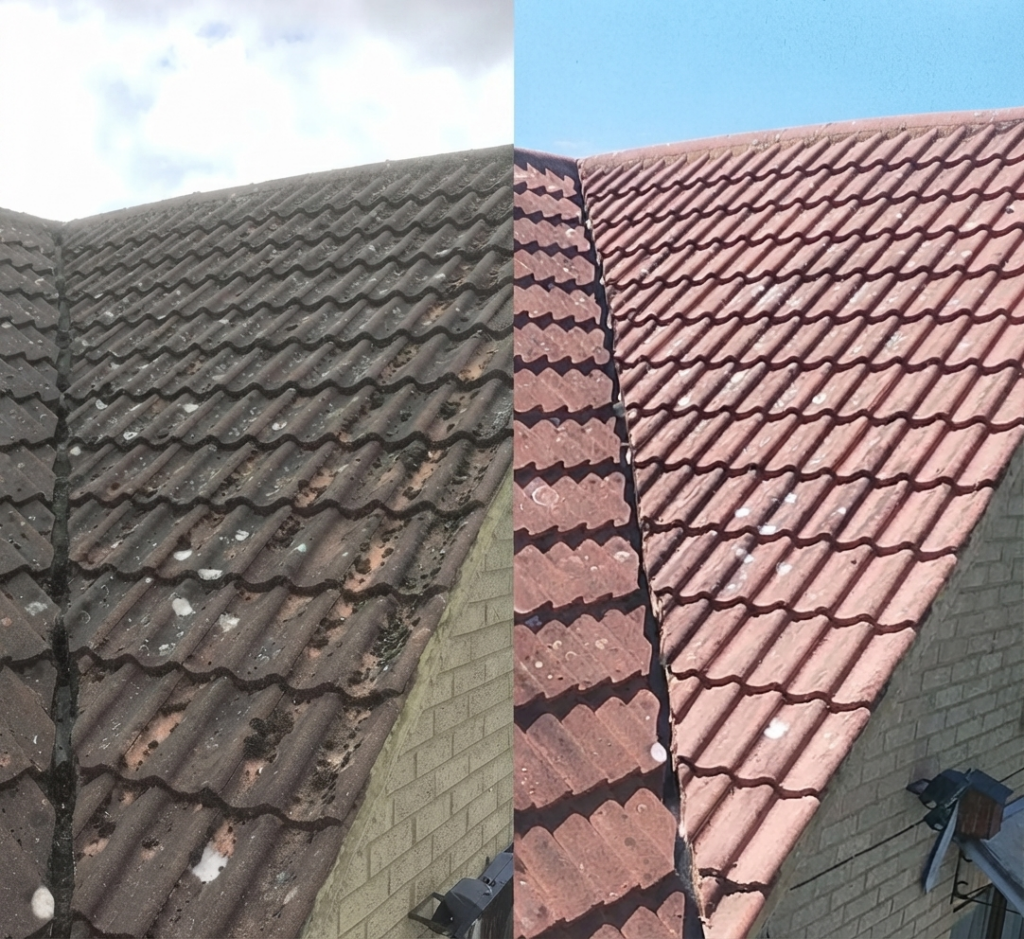
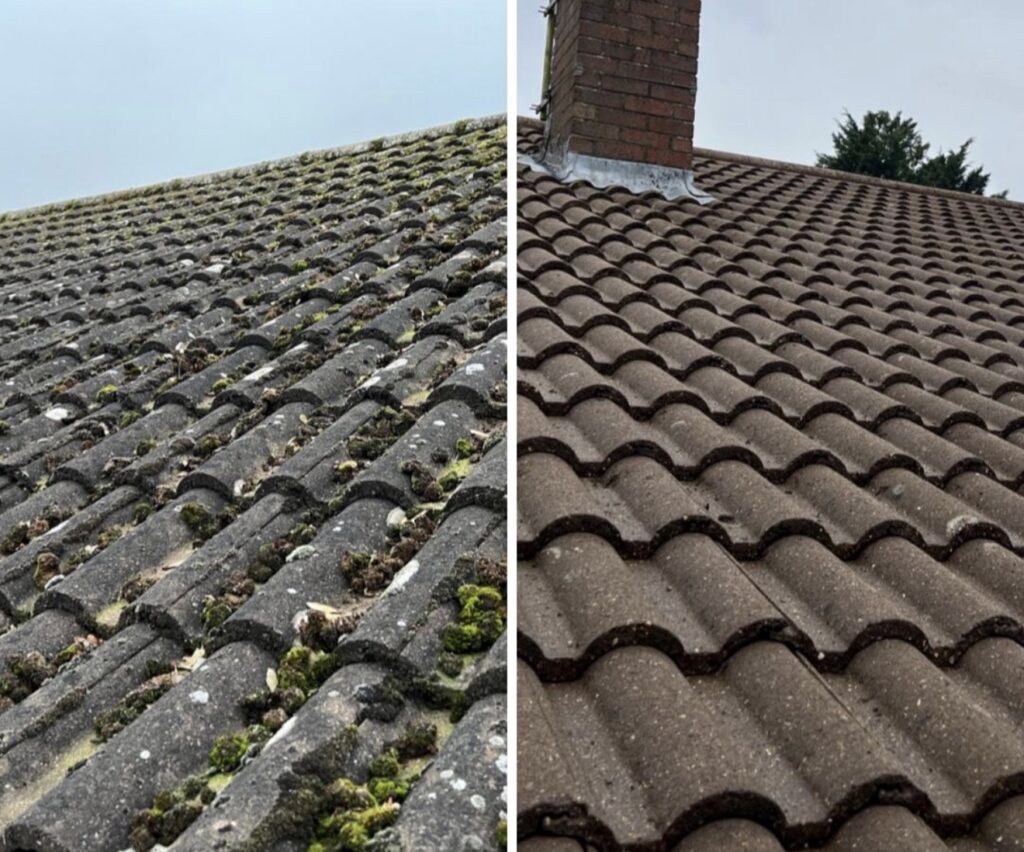
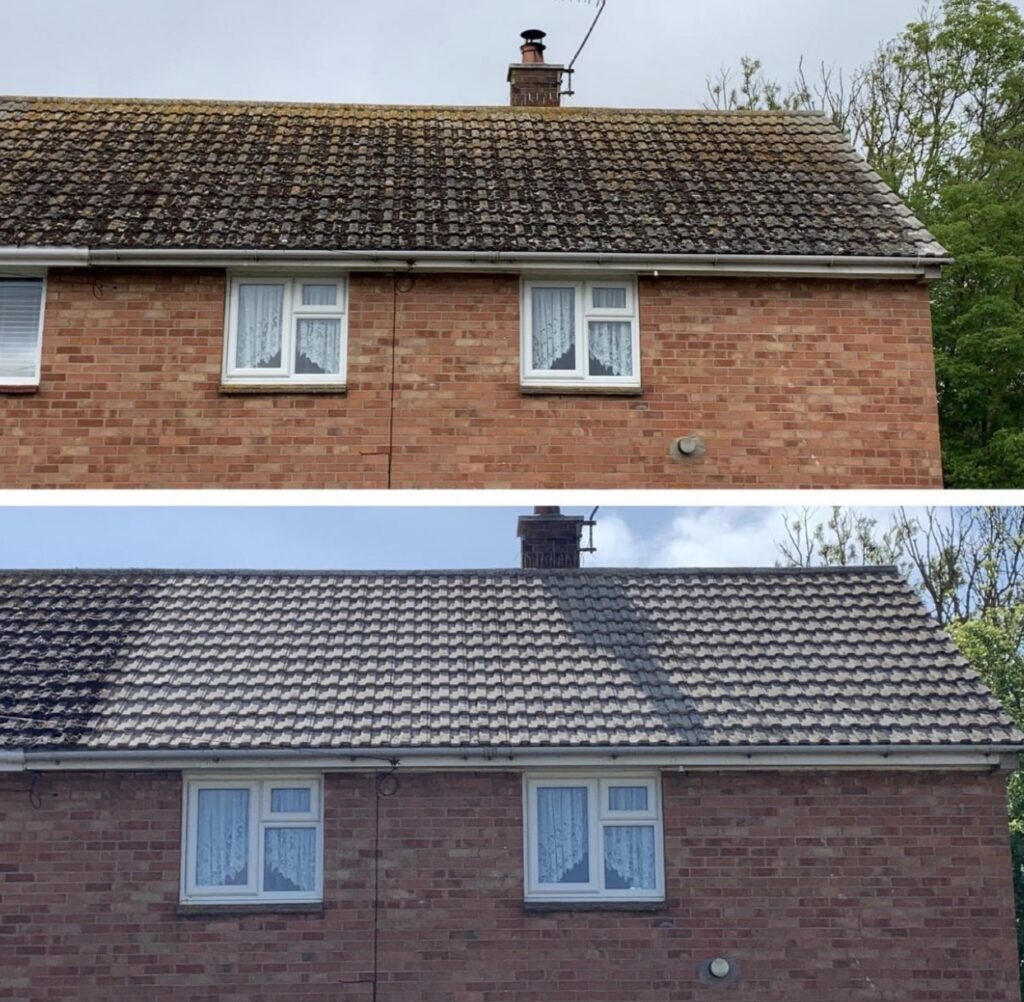
Our own photographs
Images from Sky Scrapers Ltd work showing the methods described on this page.
Where this applies locally
Towns where this comes up most often on our patch:
Roof algae: colour and pattern before treatment
Green roof tiles and black streaks can be different visible forms of organic growth. A broad green film is not the same shape as a downward dark streak, while lichen sits as a flatter crust. Look at the pattern from a safe ground position before deciding that every dark mark is loose dirt to scrub away.
For an enquiry, photograph the affected slope and a wider view of the roof. Note whether one side stays shaded and whether nearby gutters overflow. Those observations give context for treatment without needing you to climb up or scrape a sample off the covering. The algae, moss and lichen guide helps distinguish their appearance.
Is algae on a roof bad?
The key distinction is between surface staining and a failing covering. Black streaking by itself is not evidence that the roof needs replacing. A roof can look tired while the tiles still perform their water-shedding role. Concern about appearance should not be confused with proof of structural damage.
However, stains do not rule out a separate defect. If there are visible missing pieces, loose ridges or a leak indoors, describe those as well. The cleaning enquiry can address the growth while a repair concern is assessed on its own. Do not assume a treatment will resolve every roof problem simply because the two are visible together.
Roof algae removal: judge the process, not the spray
The useful treatment question is whether the organism is being addressed without damaging the tile surface. Low-pressure softwash and biocide treat organic growth; forceful washing can strip a weathered covering. Choosing a stronger spray or scrubbing every last shadow does not automatically give a better result.
Algae staining can fade over the weeks after treatment as dead growth weathers away. Compare the agreed method and expected timescale rather than demanding an immediate uniform colour. On a roof with both algae and thick moss, the removal stage and treatment stage need to be distinguished in the quotation.
Preventing black streaks returning
Shade, aspect and surrounding trees affect how quickly the roof dries, so one slope can develop growth before another. Treatment slows regrowth but does not change those conditions permanently. Keep the gutters working and observe the affected slope from the ground rather than choosing a fixed repeat date only from its colour.
If you ask about the best roof algae remover, include the tile material if known and explain any previous clean. An individual assessment can distinguish a maintenance treatment from a full moss-removal job. The softwashing service explains the low-pressure method and the biocide guide explains the gradual finish.
Choose the relevant next step
Want a professional to handle it?
Get the streaking treated properly
Send a photo of the affected slope and we can usually tell you what you are dealing with before we quote.
Sky Scrapers Ltd · info@sky-scrapers.co.uk
Questions we get asked
Are black streaks a sign my roof is failing?
No. It is surface colonisation by algae, not a structural problem. It affects appearance rather than the integrity of the covering.
Why is only one slope streaked?
Aspect and shade. The slope that dries slowest holds the moisture the algae need, so colonisation is uneven across the same roof.
Will the streaks disappear the day you finish?
Usually not entirely. Biocide keeps working after we leave and the dead growth weathers off over the following weeks.
Will they come back?
Eventually, everywhere does. How fast depends on shade, aspect and surrounding trees, which is what determines a sensible re-treatment interval.
Why does my roof have black streaks?
Algae establish where moisture lingers and spread with rainwater run-off. Shade and roof aspect help explain why one slope is more affected.
Why is algae growing on my roof?
The growth establishes where tiles remain damp. Shade, aspect and surrounding trees affect drying and can make growth uneven.
Are black streaks on a roof harmful?
Streaking alone is surface growth rather than proof of a structural fault. Describe separate defects or leaks so they are not mistaken for a cleaning issue.
How do I get rid of black streaks on a roof?
Our approach uses low-pressure softwash and biocide rather than forceful washing. Dead growth can weather away over the following weeks.
Short answer
It is algae, not dirt. Pressure washing removes the stain and speeds up its return; low-pressure biocide treatment removes the organism and slows it down.
Related services
Covering Bedfordshire and surrounding counties