Crusty lichen on roof tiles and why it is harder to shift than moss
Lichen is the flat, crusty grey, white or orange growth that looks painted onto the tile. It is not moss, it does not lift off in mats, and it takes considerably more patience to deal with.
We see the worst of it on clay peg tiles and older slate in the Chiltern-facing parts of Luton and around the damp valley floors in Hitchin and Shefford.
Why it grips so hard
Lichen is a symbiotic organism — fungus and alga together — and the fungal component physically bonds into the surface of the tile. On a porous, weathered clay or concrete tile it is anchored into the material rather than sitting on top of it.
That is why hard scraping does not solve it. Get aggressive enough to lift every trace and you take tile surface with it; leave the anchored material and it regrows from what remains.
The realistic approach
- Remove the bulk growth by hand, working along the courses rather than across them.
- Treat the whole covering with biocide so what remains anchored in the surface is killed rather than trimmed.
- Accept that residual ghosting on very porous tiles weathers off gradually rather than disappearing on the day.
- Never use a pressure lance — on lichen-affected clay it removes tile, not just growth.
Where we see it most
Damp, sheltered, chalk and clay locations with clean air. Lichen is famously sensitive to air pollution, so it thrives on rural and semi-rural roofs: the Chiltern edge above Luton and Dunstable, the Hiz valley through Hitchin, the greensand villages around Woburn Sands, and the Ouse valley towards Newport Pagnell.
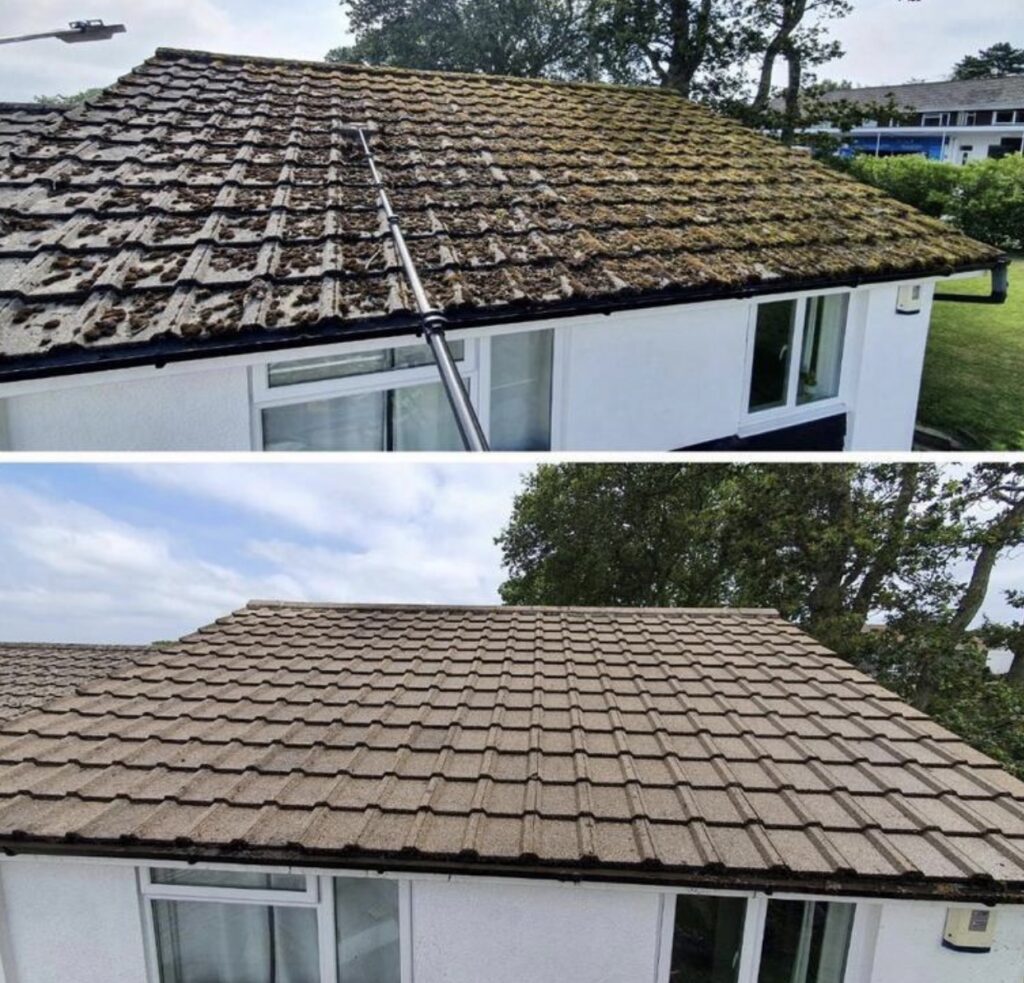
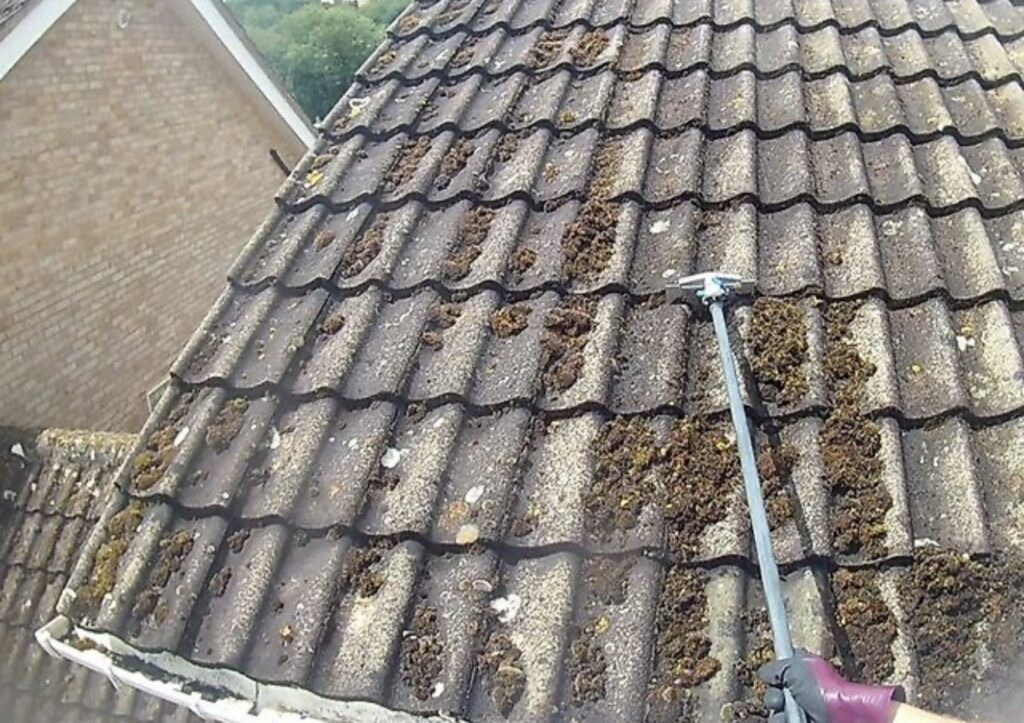
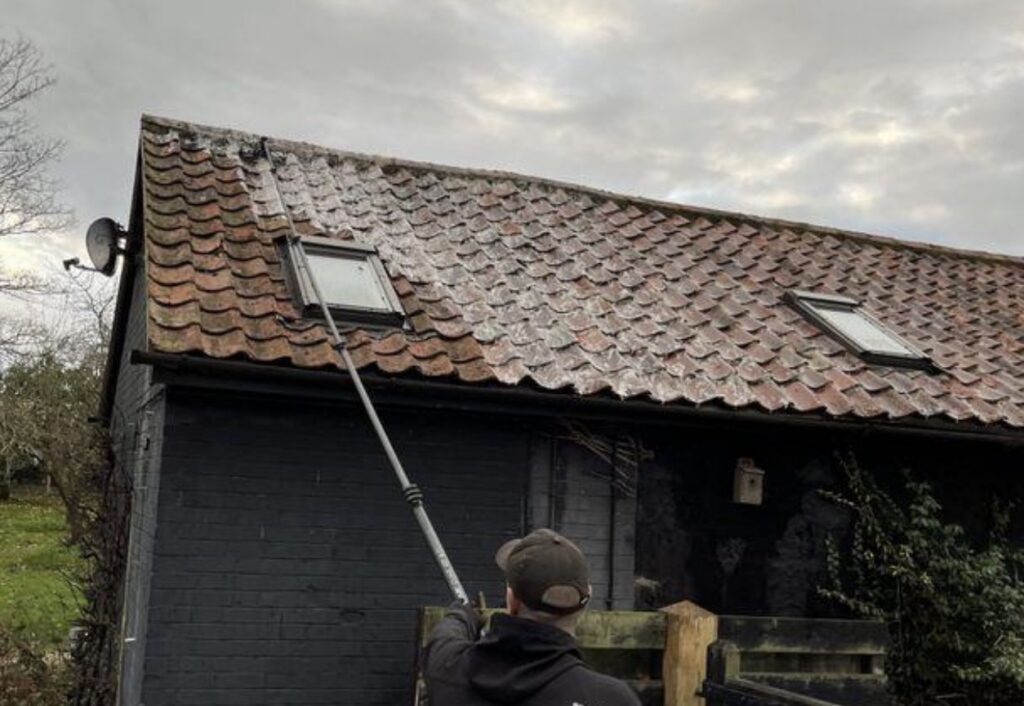
Our own photographs
Images from Sky Scrapers Ltd work showing the methods described on this page.
Where this applies locally
Towns where this comes up most often on our patch:
- Softwashing & Biocide Treatment in HitchinHertfordshire · SG4
- Softwashing & Biocide Treatment in LutonBedfordshire · LU1
- Softwashing & Biocide Treatment in Woburn SandsBuckinghamshire · MK17
- Softwashing & Biocide Treatment in SheffordBedfordshire · SG17
- Softwashing & Biocide Treatment in Newport PagnellBuckinghamshire · MK16
- Clay peg, plain and pantile roofs cleaned without breaking nibsRoof covering
- Black streaks running down your roof tilesCommon problem
- Period and listed property roofs cleaned entirely by handBuilding type
Questions we get asked
Is lichen worse for the roof than moss?
It holds less water than moss, so it does less to block drainage, but it bonds into the tile surface and is much harder to remove cleanly. Structurally moss is the bigger nuisance; visually lichen is the more stubborn.
Why can't you just scrape it all off?
Because the fungal component anchors into the tile. Scraping hard enough to remove every trace removes tile surface as well, which makes the next colonisation faster.
Will the roof be spotless afterwards?
On sound tiles, close to it. On very porous or weathered tiles you may see faint ghosting where the growth was, which weathers off over the following months.
Does lichen mean my air quality is good?
Broadly, yes — lichen is intolerant of heavy air pollution, which is why it is most abundant on rural and semi-rural roofs.
Deal with lichen the slow, correct way
Lichen jobs take longer than moss jobs and we would rather set that expectation before quoting. Send us a close-up photo.
Sky Scrapers Ltd · info@sky-scrapers.co.uk
To sum up
Lichen is bonded into the tile, not sitting on it. Hand removal plus biocide is the only approach that does not cost you tile surface.