
Roof moss around solar panels needs a different plan, not a bigger brush
A solar array covers a section of roof completely, and that has two consequences most homeowners do not think about until they see it: the tiles at the panel edges and underneath the mounting rails get almost no rainfall to naturally wash them, and any moss growing at the array perimeter is now within reach of cabling and mounting hardware you really do not want disturbed.
We clean around solar installations on the understanding that the panels, cabling and mounting system are someone else's equipment to touch — our job is the roof, worked carefully in relation to what sits on it.
Why moss concentrates around an array
Panels shed rainfall off their own edges rather than letting it run evenly across the tile below, which means the perimeter of an array often gets more concentrated flow while areas directly underneath rails get almost none. That uneven wetting pattern creates exactly the damp, undisturbed conditions moss needs, often in a visible ring around the array edge.
What we do and do not touch
- Roof tiles around the array perimeter and any accessible tile between rows are cleaned by hand as normal.
- We do not walk on, lean on, or apply any cleaning solution directly to panel glass.
- Cabling, junction boxes and mounting rail brackets are worked around, not moved or handled.
- Where moss has grown up against or under a rail foot, we clear what is safely reachable without disturbing the fixing.
The limits of what we can reach
Some tile beneath a densely packed array is genuinely inaccessible without disturbing the panels themselves, and we will not do that. We clean everything we can reach safely and tell you plainly if there is a section we cannot get to without involving whoever installed the system.
Debris at the bottom edge of the array
Leaves, moss fragments and general roof grit collect against the lower edge of a panel array, where the pitch and the panel frame create a natural obstruction to anything washing straight down. We clear that build-up carefully without dislodging or leaning on the frames, because left alone it feeds straight into the gutter below.
It is also worth saying that clean-looking panels tell you nothing about the tile around them. Moss can be building up along the array perimeter while the glass itself looks spotless, because the two surfaces weather completely differently.
Panel efficiency and roof cleaning are different jobs
Cleaning the panel glass itself, for output and efficiency reasons, is a separate specialist job from cleaning the roof tiles around an array — we do the tile and moss side, not the panel glass itself, and would point you toward a solar-specific cleaner for that.
Our own photographs
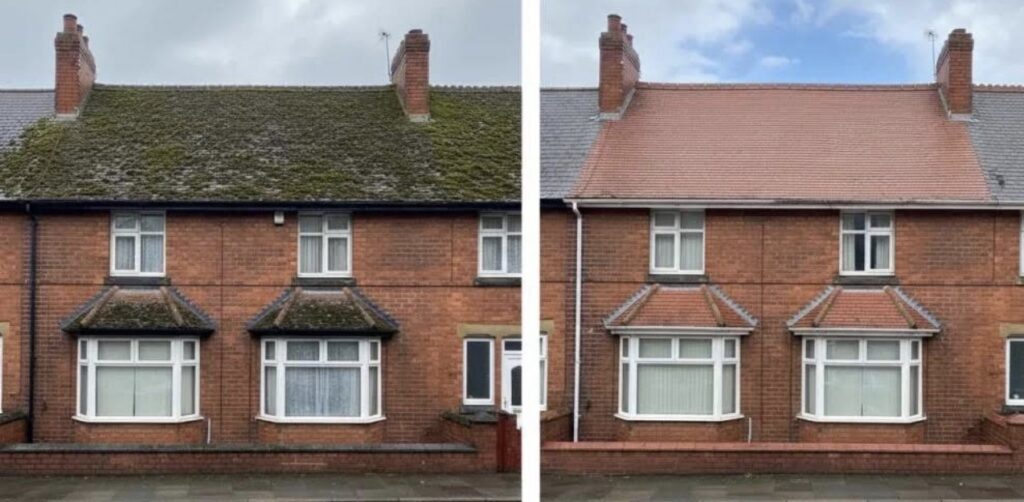
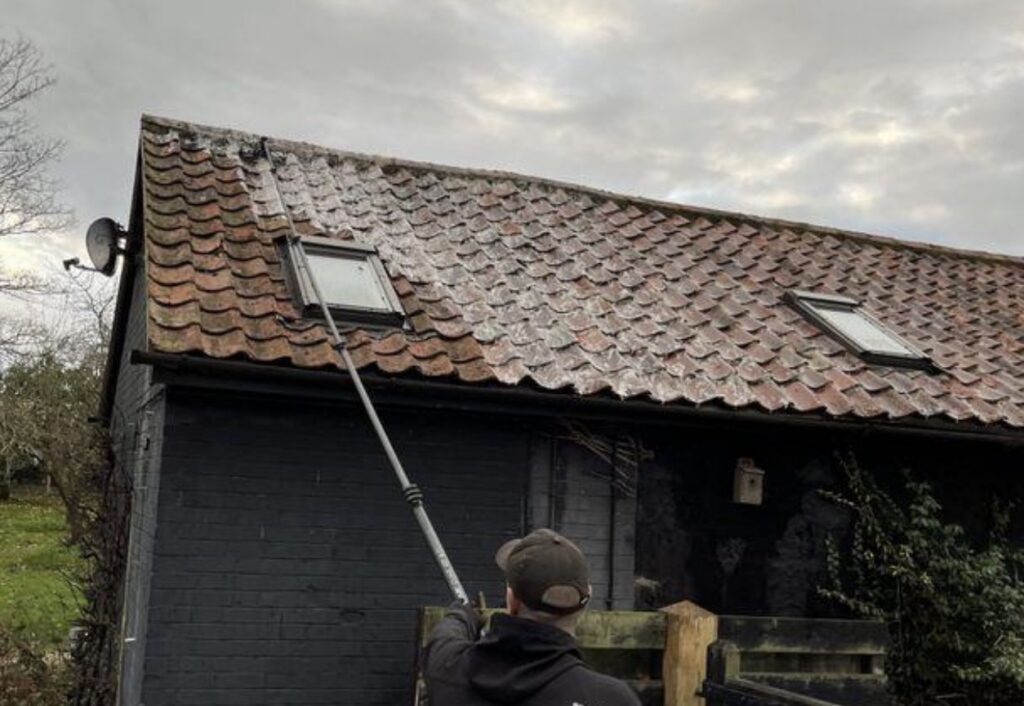
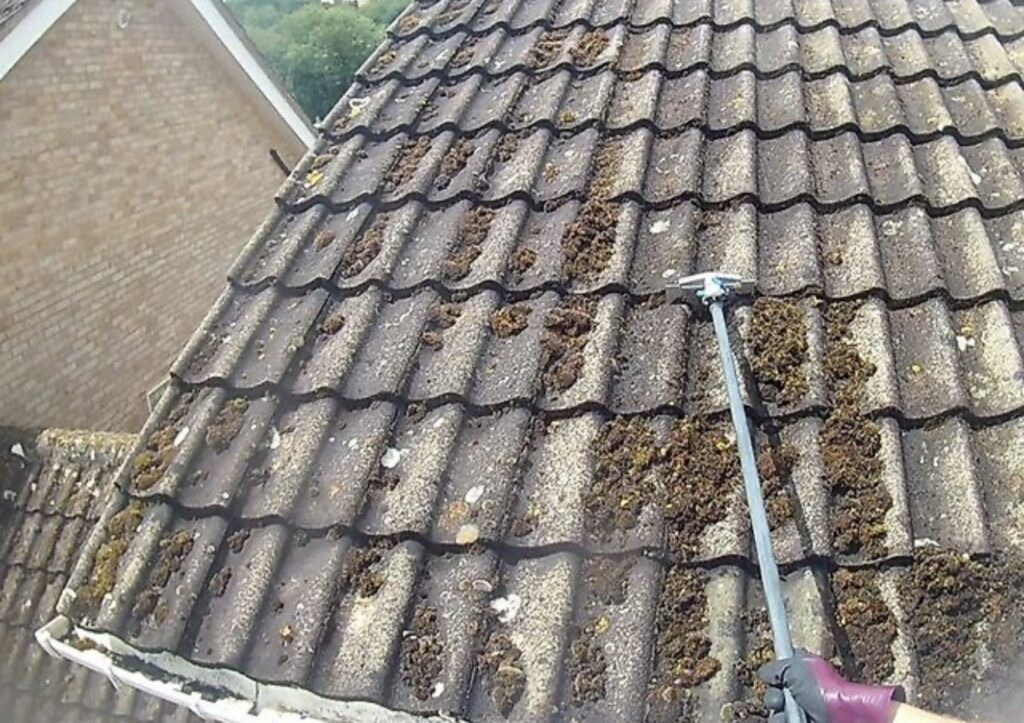
Images from Sky Scrapers Ltd work showing the methods described on this page.
Where this applies locally
Towns where this comes up most often on our patch:
- Hand Roof Cleaning in Milton KeynesBuckinghamshire · MK1
- Hand Roof Cleaning in BletchleyBuckinghamshire · MK1
- Hand Roof Cleaning in BicesterOxfordshire · OX25
- Why the north-facing slope is always the one covered in mossCommon problem
- New build roofsBuilding type
- Flat roof and felt cleaning without damaging the membraneRoof surface
Questions we get asked
Will you clean the actual solar panels?
No, we clean the roof tiles and moss around and between the array, not the panel glass itself, which is a separate specialist job.
Is it safe to clean a roof with solar panels installed?
Yes, working carefully around the array, cabling and mounting hardware without touching or disturbing any of it.
Why is there always a ring of moss right around my panels?
Panels alter how rainfall hits the roof below them — concentrated at the edges, minimal underneath the rails — and that uneven wetting pattern tends to produce a visible moss ring at the array perimeter.
Can you get underneath a densely packed array?
Only where it is safely reachable. Some tile beneath tightly spaced panels cannot be cleaned without disturbing the installation, and we will not do that — we will tell you if that applies to your roof.
Will cleaning the roof affect my solar panel warranty?
We do not touch the panels, cabling or mounting hardware during a roof clean. If your installer's terms say anything specific about roof work near the array, it is worth checking that documentation first.
Ask about cleaning around your solar array
Send a photo of the array and the surrounding tile and we can advise what is realistically reachable before quoting.
Sky Scrapers Ltd · info@sky-scrapers.co.uk
In short
Solar panels change how rainfall behaves on a roof and create moss patterns you would not otherwise see. We clean carefully around the array without touching the equipment itself.