How to clean roof tiles without making the problem worse
To decide how to clean roof tiles, start by identifying what needs attention. Thick moss, green film and crusty lichen behave differently. A roof with a drainage problem also needs a different priority from a sound roof carrying a light cosmetic stain.
This is a tile-care sequence, not a set of instructions for climbing onto a roof. It explains how to observe the covering safely, what a suitable clean should achieve and which questions to ask before any tools or treatment are chosen.
Step one: observe from the ground
Look at the affected slope in good light from a safe position. Notice whether the growth forms cushions, streaks or flat crusts. Include the gutters in the assessment: moss at the eaves and overflow during rain can make drainage the more immediate concern.
Take photographs without climbing or leaning from a ladder. A wider image shows the roof shape and access, while a safely taken zoomed image may show the growth. You do not need to touch the tiles to make the first enquiry useful.
Step two: identify the covering and condition
The cleaning plan should consider the tile material, shape and condition. Older or weathered tiles are not a reason to use more force. Missing pieces, loose ridges and visible defects need to be considered before cosmetic cleaning starts.
If you know the covering or have previous roof paperwork, include that information. If you do not, send photographs rather than guessing. Cleaning should preserve the existing surface; it is not a way to make an old covering structurally new or to hide an unresolved defect.
Step three: distinguish removal from treatment
Hand cleaning removes the bulk of moss from tiles and drainage routes. A biocide treatment works on living growth and spores that remain. Those stages are connected but not interchangeable: spraying a thick moss cushion is not the same as clearing it off the roof.
Sky Scrapers cleans roofs by hand without high-pressure washing, clears moss from tiles, valleys and ridge lines and uses low-pressure treatment. Ask how those stages suit the growth on your roof, rather than deciding beforehand that every tile needs the same amount of scraping.
Step four: protect drainage as the roof is cleared
Material lifted from the roof must not simply be left in the gutter. The clean should account for moss and debris reaching the roofline and for downpipe flow afterwards. That is particularly important where the original concern is water overflowing onto walls or paths.
When comparing quotations, check the gutter stage explicitly. A clean-looking slope above a blocked outlet is an incomplete answer to a drainage complaint. Explain where overflow happens and whether it follows rain or the shedding of moss from above.
Step five: understand the gradual finish
Lichen and algae staining can fade after treatment as dead growth weathers away. The visible result is not always complete on the day that bulk moss is removed. Ask what is expected immediately and what should change over the following weeks.
Do not scrub harder just because a crust or shadow remains. On porous tiles, aggressive removal can take the surface with it. A realistic expectation about staining protects the covering and avoids repeating work unnecessarily while a treatment is still taking effect.
How to clean a roof without getting on it
Safe professional access is chosen for the property, and some areas may be reachable from suitable equipment without walking directly on the covering. That does not make a long brush or spray from the garden a universal answer. Roof height, pitch, obstructions and the position of the growth affect the method.
For a homeowner, the safe first step without getting on the roof is observation and an enquiry, not reaching further with improvised equipment. The separate DIY-versus-professional guide compares the wider decision. Here, the priority is a tile-appropriate sequence and a clear assessment of access.
What changes the cost of cleaning roof tiles?
The area, pitch, covering, access and amount of growth all affect the quotation. Gutters, valleys and any related work also change the scope. A small roof with easy access should not be compared directly with a complex covering above extensions.
Ask for the removal, treatment and drainage stages to be described alongside the price. The roof-cleaning cost guide explains those factors in depth. For a practical next step, send photographs and your postcode or town for a free, no-obligation quote.
Our own photographs
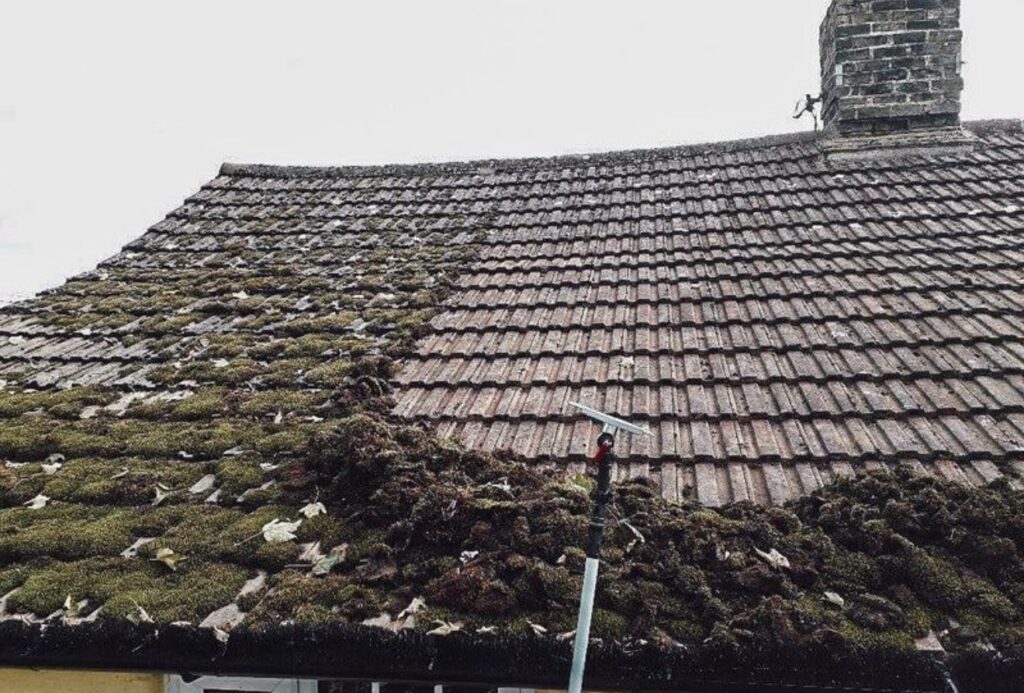
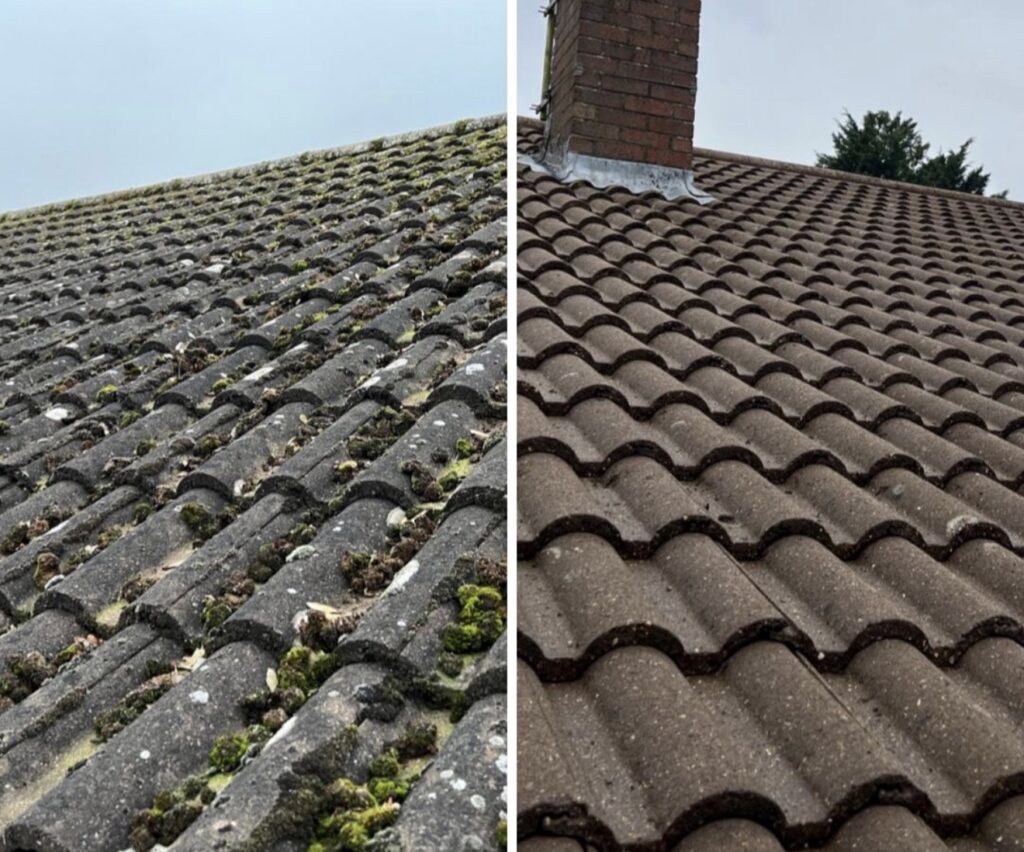
Sky Scrapers Ltd photographs of roof and roofline work.
Related cleaning advice
Compare the relevant methods and read about the next step.
Want a professional to handle it?
Get a hand roof-cleaning quote
Send photographs taken from a safe position and tell us what needs attention. Use our enquiry form below or call for a free, no-obligation quote.
Sky Scrapers Ltd · info@sky-scrapers.co.uk
Questions we get asked
How should a roof be cleaned in the UK?
Assess the covering, growth, drainage and access first. We use hand cleaning rather than high-pressure washing, followed by suitable low-pressure treatment.
How can I clean a roof without getting on it?
Begin with ground-level observation and photographs. A professional must assess suitable access; reaching from the ground is not automatically feasible or safe for every roof.
Should every trace of lichen be scraped off?
No. Aggressive scraping can remove tile surface. Treatment and gradual weathering are part of our approach to stubborn lichen.
Does roof tile cleaning include gutters?
Check the scope. Moss and debris removed from above need clearing from the gutter, with downpipe flow considered afterwards.
What affects roof tile cleaning cost?
Roof area, pitch, covering, condition, access and the removal, treatment and gutter stages all affect an individual quotation.
The practical decision
Identify the growth, protect the tiles and keep drainage working. Choose the process for the actual roof rather than relying on force or a universal spray.
Related services
Covering Bedfordshire and surrounding counties