
How does soft washing work?
In one sentence: soft washing works by applying a cleaning and biocidal solution at very low pressure, letting it kill the growth at the root, and then letting rain and a gentle rinse carry the dead material away, so the surface is cleaned without being blasted. On a house that means roofs, render and uPVC come clean without the damage a jet wash can cause.
Soft washing is one of those trade terms that sounds like marketing until somebody explains it properly. It simply means cleaning a surface chemically at very low pressure instead of blasting it mechanically at high pressure.
For roofs, render, cladding and uPVC that distinction matters enormously, because the fastest way to clean these surfaces is also the fastest way to ruin them. This guide covers what soft washing does, what it does not do, and how to judge whether it is right for your property.
What actually happens during a soft wash
A biocidal solution is applied evenly to the surface at roughly garden-hose pressure. The solution kills algae, lichen and moss at the root and breaks down the biological film that gives tiles and render that dull green-black cast.
Nothing is stripped away by force. The dead organic material then weathers off over the following weeks and months, helped along by ordinary rainfall. On lighter surfaces a gentle rinse finishes the job; on roofs we usually leave the weather to do it.
Why pressure is the enemy on most exteriors
- Concrete roof tiles have a factory surface that weathers slowly. High pressure removes it, exposing porous material that then colonises faster than before.
- Water driven upwards under tile laps ends up in the roof space rather than in the gutter.
- Render, particularly modern thin-coat and silicone systems, cracks and crazes under a lance and can be stripped back to the mesh in seconds.
- Old mortar in ridge and verge joints is washed out, turning a cleaning job into a repair job.
- uPVC fascias and cladding scar and dull permanently where a lance has been held too close.
Which surfaces suit soft washing
Pitched roofs of every common covering, including concrete interlocking tiles, clay plain tiles and pantiles, natural slate, fibre cement and even fragile older coverings that could never take mechanical cleaning.
Rendered walls, painted masonry, K-Rend and other silicone systems, uPVC fascias, soffits, cladding, conservatory frames and roofs, and garden structures. Anywhere the finish is worth more than the dirt sitting on it, soft washing is the right method.
What soft washing will not do
It will not remove thick moss cushions on the day. Biocide kills them, but dead moss still has to leave the roof, either by hand or by weather over a long period. That is why heavily mossed roofs get a hand clean first and a soft wash afterwards.
It will not reverse weathering, lift staining that has come from rusting fixings or overflowing gutters, or repair anything. It is a cleaning and prevention method, not a restoration coating.
It will also not give you an instant transformation on a roof. If somebody promises a dramatic before-and-after within the hour on a heavily colonised roof, they are pressure washing it.
Timescales and what to expect
Render and uPVC usually look markedly better the same day, because the film is thin and can be rinsed gently once it has lifted. Roofs are slower. Expect the colour to keep improving for six to twelve weeks as the dead growth breaks down and washes off in the rain.
That gradual change is a sign the method is working correctly rather than a sign of a poor job. The trade-off for patience is a roof covering that is still intact at the end of it.
Safety around the property
Solution strength is matched to the surface and the level of colonisation. Planting below the work area is sheeted or wetted down, glazing and paintwork are protected, and pets are kept indoors while the treatment is going on.
Our team is fully insured and uniformed, works from our own equipment and applies treatments from safe access rather than from a stretched ladder position. If the weather turns during the visit, we stop, because wind and rain both waste solution and put it where it is not wanted.
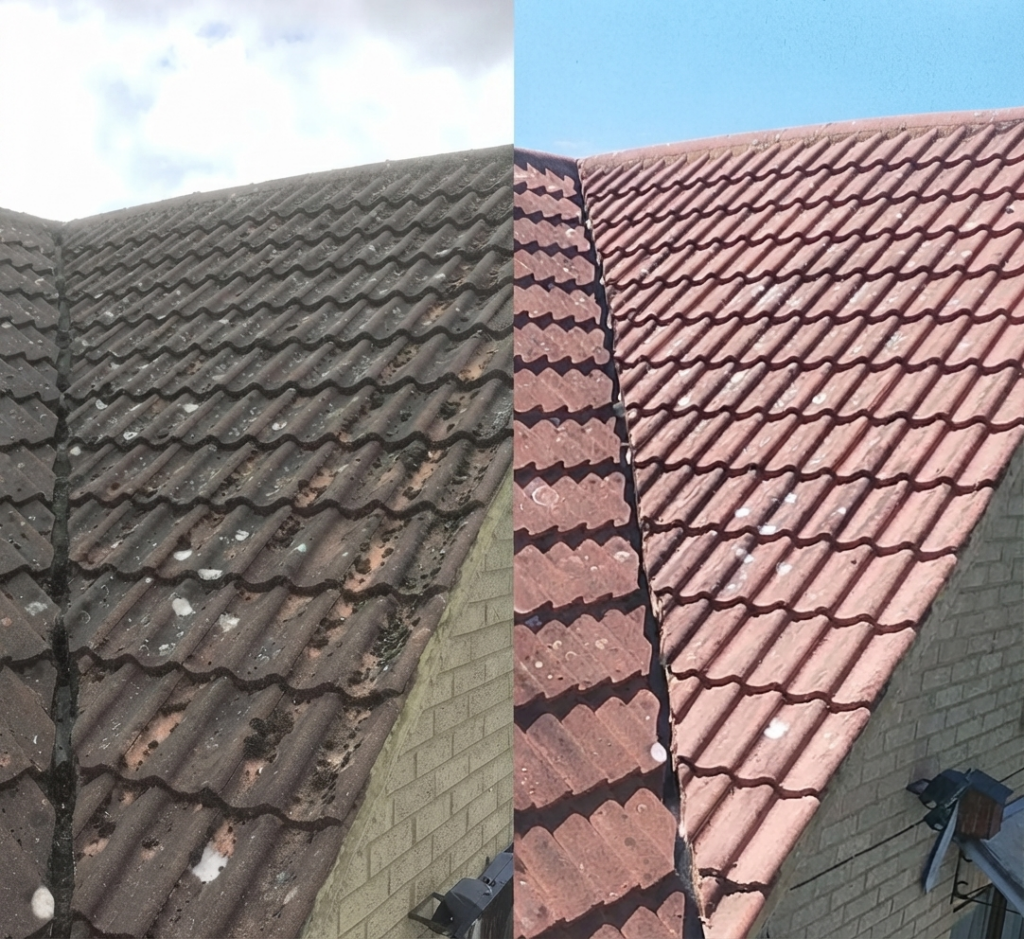
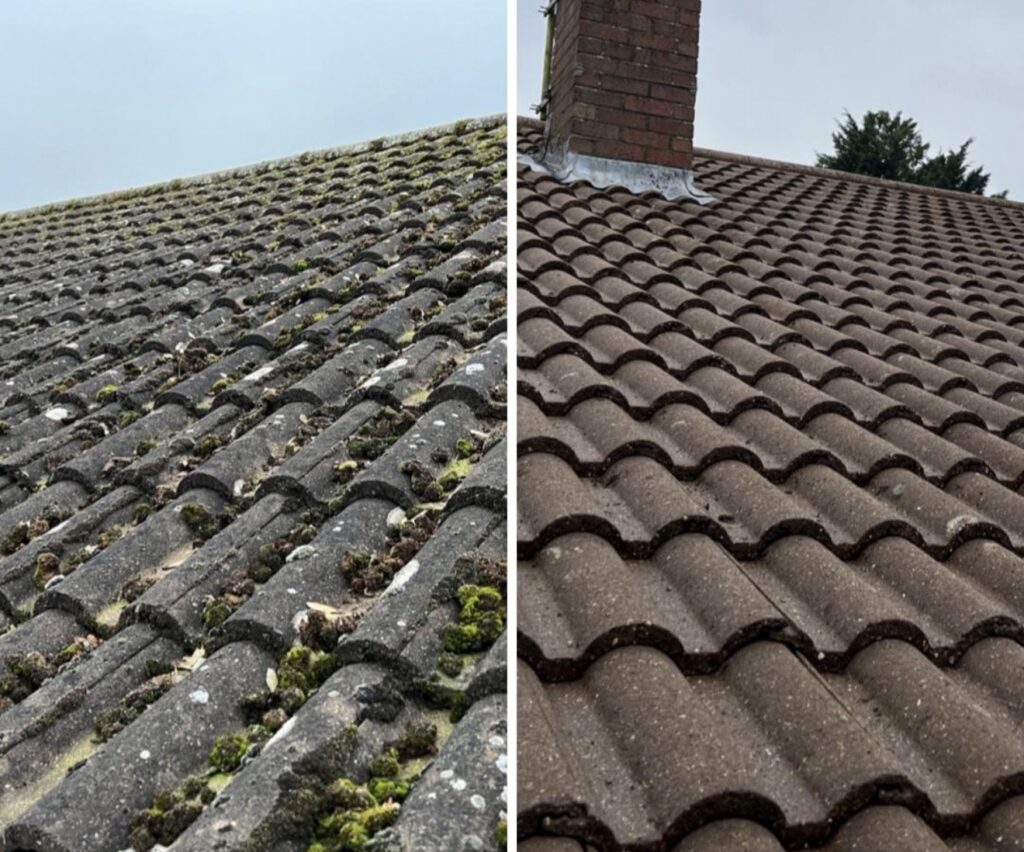
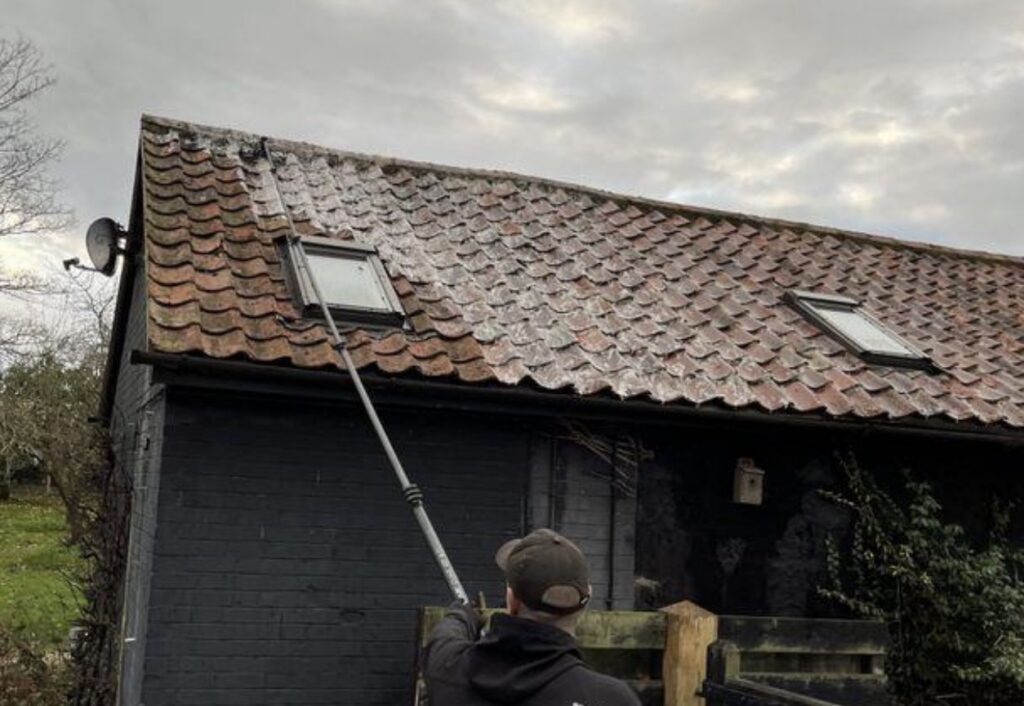
Our own photographs
Images from Sky Scrapers Ltd work showing the methods described on this page.
Where this applies locally
Towns where this comes up most often on our patch:
- Softwashing & Biocide Treatment in LutonBedfordshire · LU1
- Softwashing & Biocide Treatment in BedfordBedfordshire · MK40
- Softwashing & Biocide Treatment in Milton KeynesBuckinghamshire · MK1
- Softwashing & Biocide Treatment in AmpthillBedfordshire · MK45
- Softwashing vs pressure washingComparison
- How biocide treatment works after a roof cleanGuide
- Why pressure washing damages roof tilesGuide
Want a professional to handle it?
Ask about a soft wash for your property
Tell us the surface and send a photo, and we will tell you honestly whether soft washing alone will do the job.
Sky Scrapers Ltd · info@sky-scrapers.co.uk
Questions we get asked
Can soft washing be used on a whole house?
Yes, on the surfaces that suit it. Roofs, render and uPVC fascias and soffits are all cleaned at low pressure. We check each surface first and tell you if any part of the house needs a different approach.
Why does a soft washed roof not look spotless on the day?
Because the solution kills the growth rather than tearing it off. Staining and lichen fade over the following weeks as the dead material weathers away, which is normal and a sign the treatment is working.
Is soft washing the same as jet washing?
No. Jet washing removes dirt mechanically with high pressure. Soft washing removes it biologically at very low pressure, so the surface underneath is left intact.
How long do the results last?
On a roof, a full clean and treatment holds the finish for years rather than months, and our full roof cleans carry a written 24-month biocide guarantee. Shaded surfaces under trees always recolonise faster.
Is it safe for plants and pets?
With sensible precautions, yes. We sheet or water down planting before treatment and ask that pets stay indoors while we are applying. See our guide on biocide safety around plants and pets.
Can soft washing be used on its own?
On lightly soiled roofs, render and uPVC, yes. On roofs carrying thick moss, it is used after hand clearing rather than instead of it.
Will it damage my render?
Correctly applied, no. Soft washing is the recommended approach for modern thin-coat and silicone render precisely because pressure washing damages them.
In short
Soft washing cleans chemically at low pressure so the surface underneath survives. It suits roofs, render, cladding and uPVC, works gradually rather than instantly, and is used alongside hand clearing where moss is heavy.
Related services
Covering Bedfordshire and surrounding counties