
How biocide treatment works after a roof clean
Cleaning removes what is already growing on a roof. Biocide treatment is the separate step that addresses what is left behind — the microscopic spores, root fragments and residual organic matter that cleaning alone cannot fully eliminate, and that would otherwise re-establish within a single season.
It is worth understanding what this step actually does, because it is the part of the job that is easiest to skip for a lower price, and the part that determines whether a clean roof stays that way for a reasonable length of time.
What the treatment does chemically
Biocide solutions are formulated to be lethal to moss, algae and lichen at a cellular level. Applied after cleaning, the solution penetrates into the tile surface and any remaining organic residue, disrupting the growth's ability to survive and re-establish. It is not a coating or a sealant sitting on top of the tile — it works into the surface itself.
Because it targets biological growth specifically rather than acting as a barrier, it does not change the colour, texture or appearance of the tile once it has dried and any residue has weathered off.
What happens in the following weeks
- Any residual growth missed during hand cleaning continues to die back and often lightens or blackens before weathering away.
- Rain gradually washes residue off the roof and into the gutters over the following weeks — this is a normal part of the process.
- The roof may look slightly different in colour immediately after treatment compared with a month later, once residue has fully weathered.
- New growth is slowed rather than permanently prevented, because spores are constantly present in the environment.
Why treatment is not a permanent seal
No responsible roof cleaner will describe biocide treatment as a permanent fix, because nothing applied to an exposed exterior roof surface can permanently prevent biological growth in a damp UK climate. What it reliably does is extend the interval before growth becomes visually or functionally significant again, particularly on pitches that are shaded or slow to drain.
Ask whether treatment is right for your roof
Tell us the condition of your roof and we can advise whether a clean-and-treat visit or a treatment-only visit makes more sense.
Sky Scrapers Ltd · info@sky-scrapers.co.uk
Our own photographs
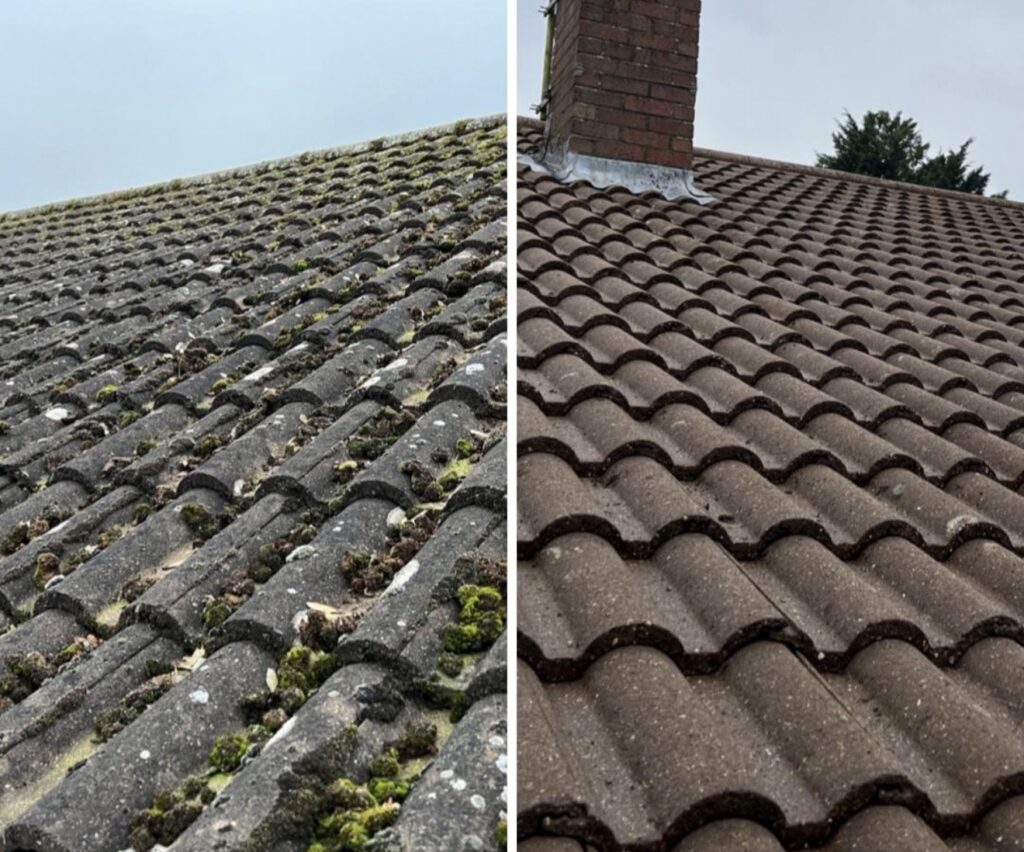
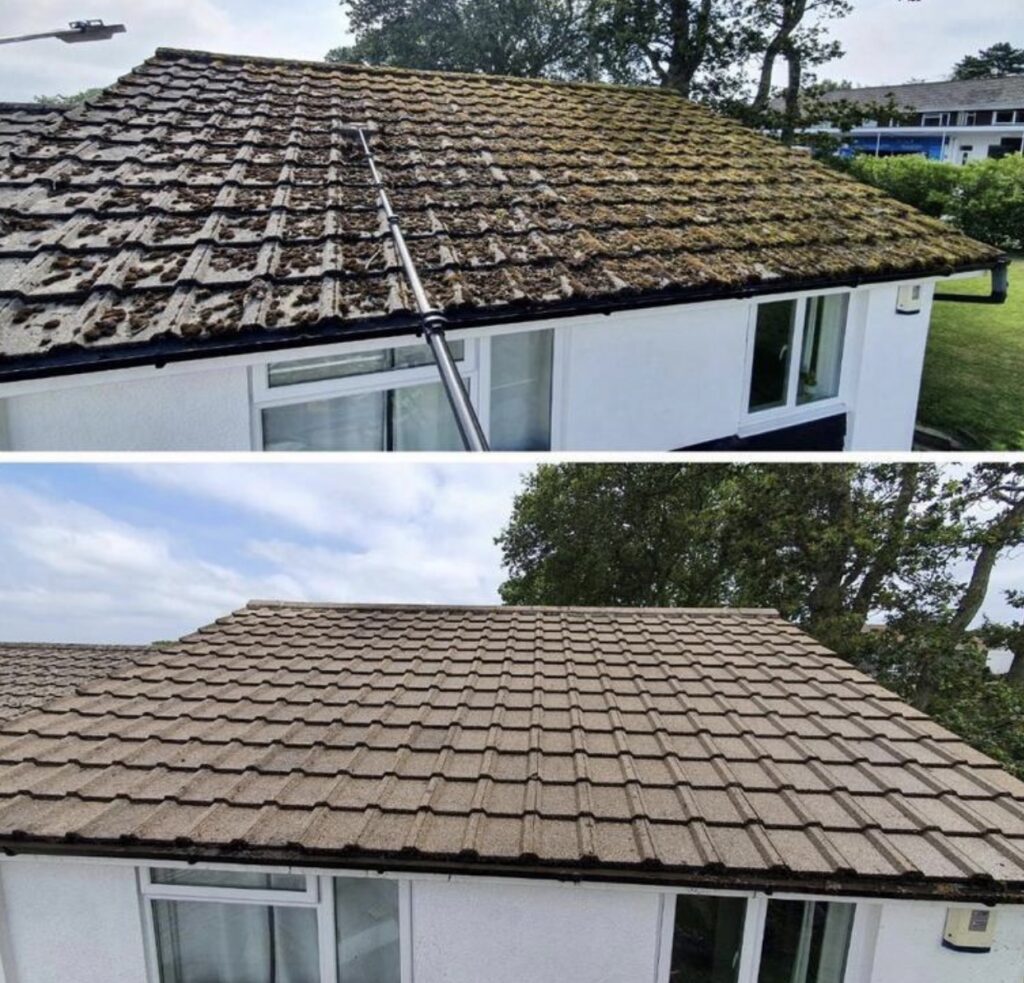
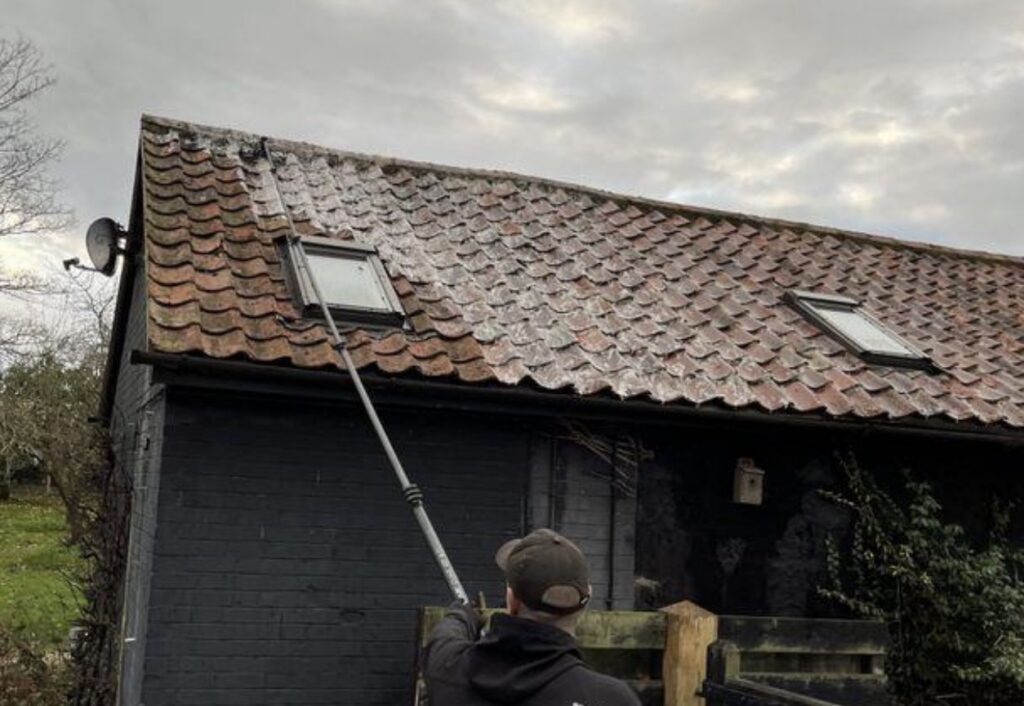
Images from Sky Scrapers Ltd work showing the methods described on this page.
Where this applies locally
Towns where this comes up most often on our patch:
Questions we get asked
Does biocide treatment smell or leave a residue?
There can be a mild chemical smell immediately after application, which dissipates quickly. Any visible residue washes off naturally with rain over the following weeks.
Is biocide safe for guttering and downpipes?
Treatments used on roofs are formulated for exterior masonry and roofing use and are applied with runoff in mind, but we take care around planting and water features nearby as a matter of course.
How long does the effect of treatment last?
It varies with pitch, aspect and shading rather than being fixed — a well-drained, sunny pitch will hold the benefit far longer than a shaded, shallow one.
Can treatment be applied without cleaning first?
It can be applied to lightly affected roofs as a preventative step, but on a roof with established moss it works far better after the bulk of the growth has been cleared by hand.
Summary
Biocide treatment works chemically on residual growth after cleaning, slowing regrowth rather than sealing the roof permanently. It is a maintenance step, most effective as part of a regular cycle.