
New build roofs: why they green up early and what actually fixes it
Homeowners are often surprised to be dealing with a green roof on a house that is barely a decade old. Modern estate roofs are not immune to algae — in several respects they show it sooner than the roofs they replaced.
Nearly every large estate we work on, from Loves Farm in St Neots to Kingsmere in Bicester, uses the same pale interlocking tile profiles, and pale tiles show organic staining long before darker ones do.
Three reasons new roofs stain early
Pale tile ranges show green film and black streaking at a fraction of the coverage that would be visible on a dark tile.
New estates sit on recently converted farmland with immature landscaping, so airborne dust and spore load is high and there is nothing to break the wind.
Dense modern layouts put houses close together, so lower and rear pitches are shaded for much of the day.
Softwash rather than scrape
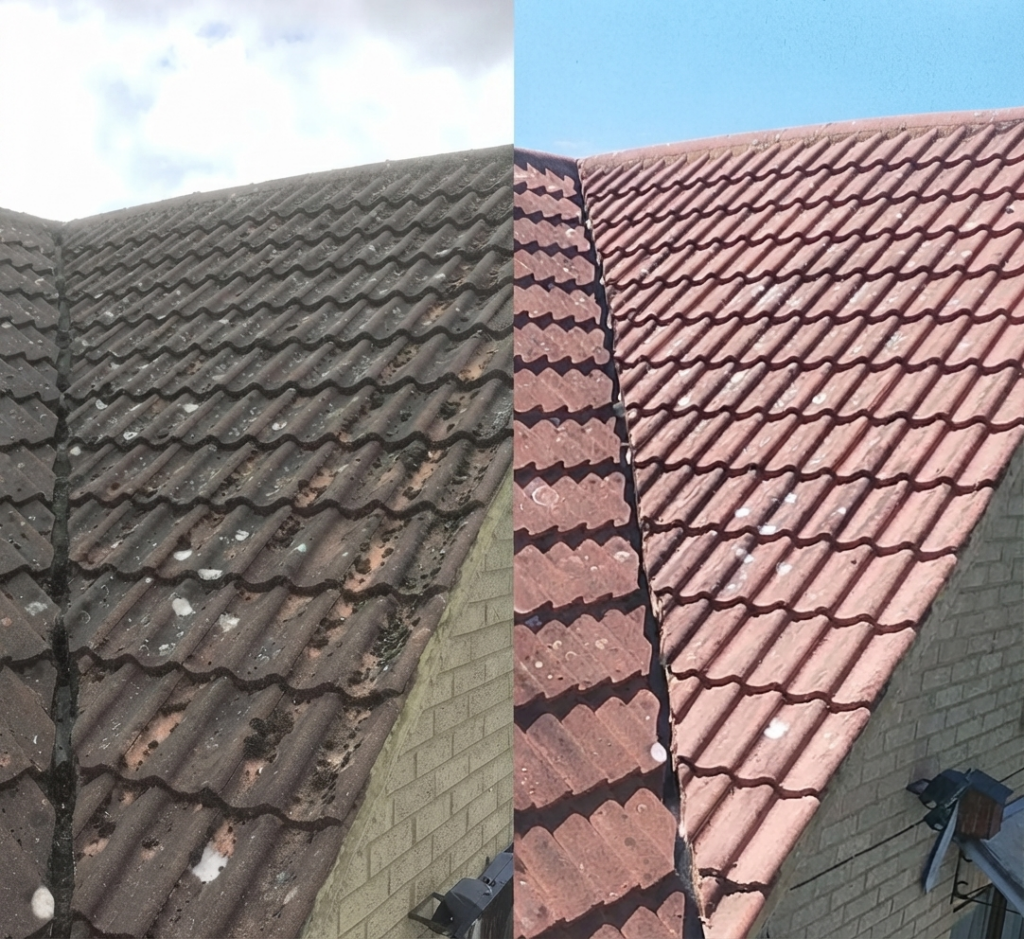
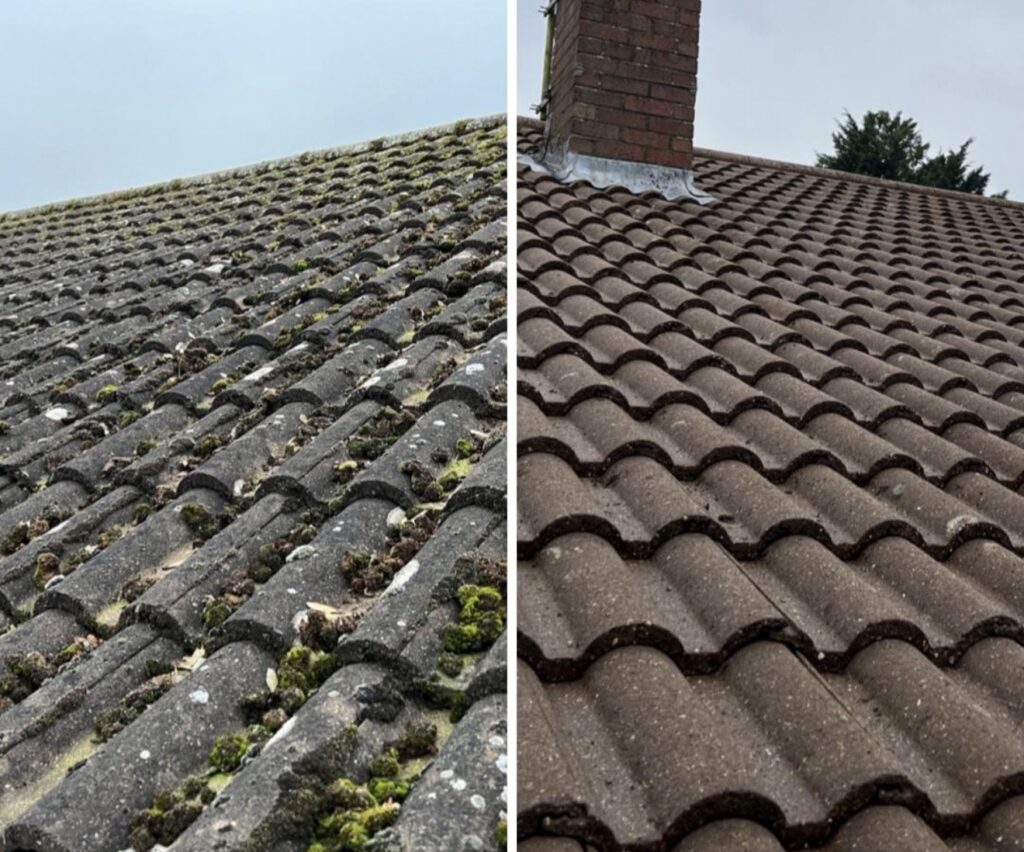
A ten- or fifteen-year-old tile is usually still smooth and sound. There is rarely a deep moss mat to lift, so the problem is film and staining rather than growth with roots. That is exactly what low-pressure softwashing plus biocide is designed for.
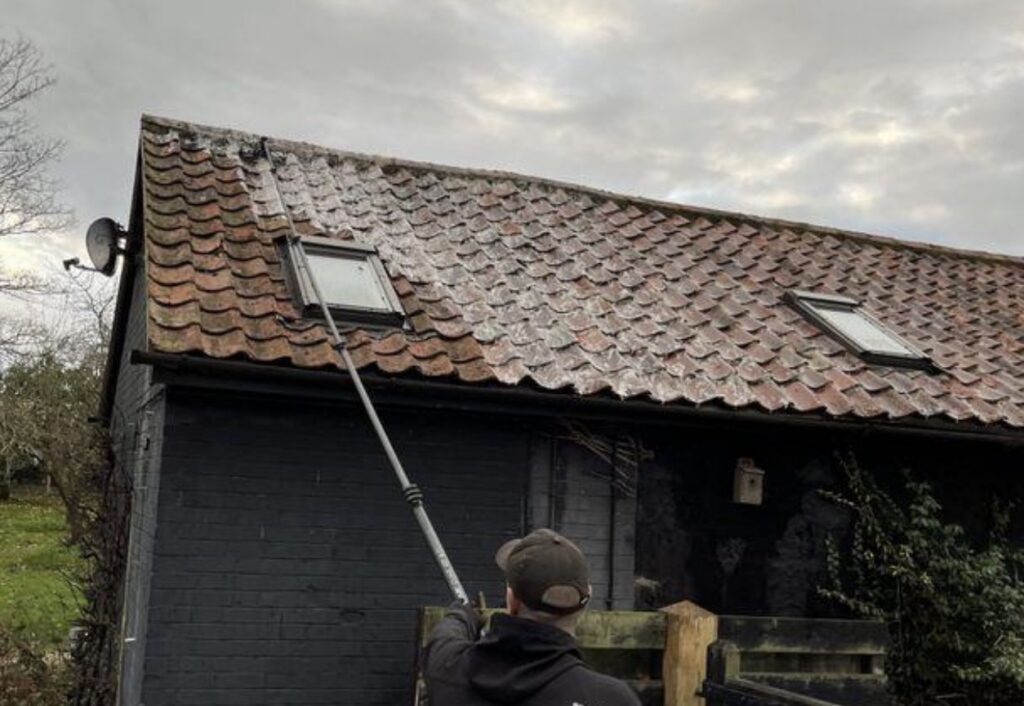
It also matters that modern roofs use dry-fix ridge and hip systems, plastic dry verges and breathable membranes. Blasting these with pressure can dislodge fixings and force water past the membrane laps, which is the sort of damage that only shows up months later.
Timing it sensibly
The practical approach on a modern roof is treatment before the staining gets established, then again when shade and aspect dictate. A south-facing front pitch may go many years; a north-facing rear pitch backing onto a landscaped belt will need it far sooner.
Our own photographs
Images from Sky Scrapers Ltd work showing the methods described on this page.
Where this applies locally
Towns where this comes up most often on our patch:
- Softwashing & Biocide Treatment in St NeotsCambridgeshire · PE19
- Softwashing & Biocide Treatment in BicesterOxfordshire · OX25
- Softwashing & Biocide Treatment in BiggleswadeBedfordshire · SG18
- Softwashing & Biocide Treatment in Houghton RegisBedfordshire · LU5
- Softwashing & Biocide Treatment in Milton KeynesBuckinghamshire · MK1
- Black streaks running down your roof tilesCommon problem
- Why the north-facing slope is always the one covered in mossCommon problem
- Is it worth cleaning the roof before selling a house?Guide
Questions we get asked
My house is only eight years old — why is the roof green?
Pale modern tiles show algae film at very low coverage, and new estates typically have high airborne spore and dust loads with immature planting. It is normal, and it is a surface problem rather than a structural one.
Will treatment affect my dry-fix ridge or verge system?
Low-pressure treatment does not disturb dry-fix components. Pressure washing can, which is one of several reasons we do not use it.
Does cleaning a new roof affect the NHBC warranty?
We cannot advise on individual warranty terms — check your own documents. What we can say is that we use no high pressure and do not alter or remove any roof component.
Is it worth treating before the staining is visible?
On a shaded north-facing pitch, often yes. Treating a lightly affected roof is quicker and cheaper than clearing an established one.
Book a softwash for your estate home
Neighbours often book together on modern estates, which makes access and set-up easier for everyone. Ask us about doing two or three houses in a run.
Sky Scrapers Ltd · info@sky-scrapers.co.uk
Summary
New roofs stain because of tile colour, exposure and shade, not because anything has gone wrong. Low-pressure softwashing and biocide treatment deal with it without touching the dry-fix components a modern roof depends on.