Commercial roof cleaning: planning it around a working building
On a house, roof cleaning is a day's work and a tidy garden. On a commercial building it is an operational question: who is underneath, what is running, when can access be taken, and what evidence does the client need afterwards.
This guide is for facilities managers, landlords, agents and business owners across Bedfordshire and the surrounding counties who need the work done without disrupting the site.
What is different about commercial work
- People underneath. Car parks, delivery bays, entrances and pedestrian routes all have to be managed while the work is going on.
- Roof types. Profiled metal, fibre cement sheeting, single-ply membrane and large flat felt areas behave very differently from domestic tile.
- Rooflights and fragile panels, which are the single biggest risk on industrial and warehouse roofs.
- Drainage volume. Commercial gutters and syphonic systems carry far more water, and a blockage causes internal flooding much faster.
- Documentation. Method statements, risk assessments, insurance evidence and photographic records are usually required rather than optional.
Getting the survey right
Every commercial job starts with a proper look at the building rather than a photograph. We need to see the covering type and condition, where rooflights sit, how the gutters run and discharge, what plant sits on the roof, and how access can be taken safely.
It is also where the practical constraints come out: opening hours, delivery windows, which car park bays can be closed, whether there are neighbouring tenants, and whether any of the work needs to happen outside business hours.
Gutters are usually the priority
On most commercial buildings, gutter maintenance matters more than appearance. A blocked box gutter or valley gutter on a warehouse does not overflow tidily down the outside; it backs up over the internal upstand and comes through the ceiling onto stock.
Regular clearing, with outlets and downpipes flushed and confirmed, is the cheapest insurance a building manager can buy. We recommend photographic before-and-after records for each run, which is straightforward to provide and useful evidence for the client, the insurer and the next visit.
Appearance, and why it earns its cost
Streaked cladding, a green office roof and stained render read as neglect to anyone visiting the site. For retail, hospitality, care and customer-facing premises, exterior condition is part of how the business presents itself, and it is far cheaper to maintain than to replace.
Soft washing suits most commercial cladding and render, because it cleans without opening the coating on profiled sheet or thinning render systems. Pressure washing a coated metal panel removes the coating that is protecting it.
Access and safety on commercial roofs
Fragile surfaces are the defining hazard. Older fibre cement sheeting, corroded profiled metal and every rooflight on the building must be treated as unable to bear weight. Work is planned to avoid loading them at all rather than to step carefully around them.
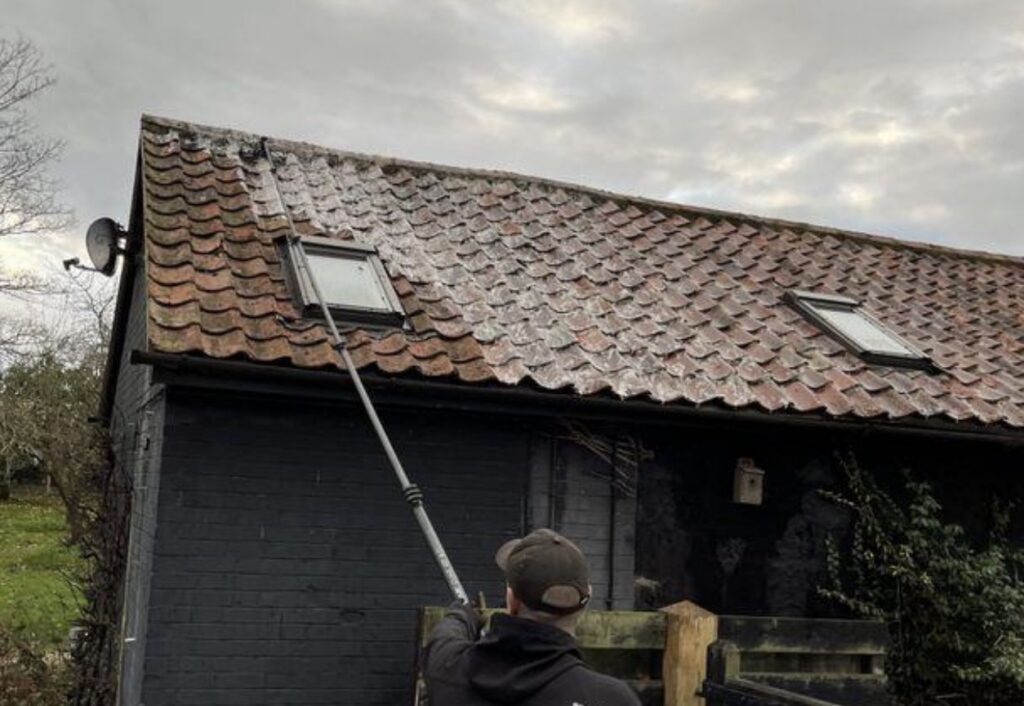
Access is chosen for the building: ladders and our own equipment where suitable, powered access where the height or the roof condition requires it. Exclusion zones below the work are set out and maintained, and the plan is agreed with the site before the day.
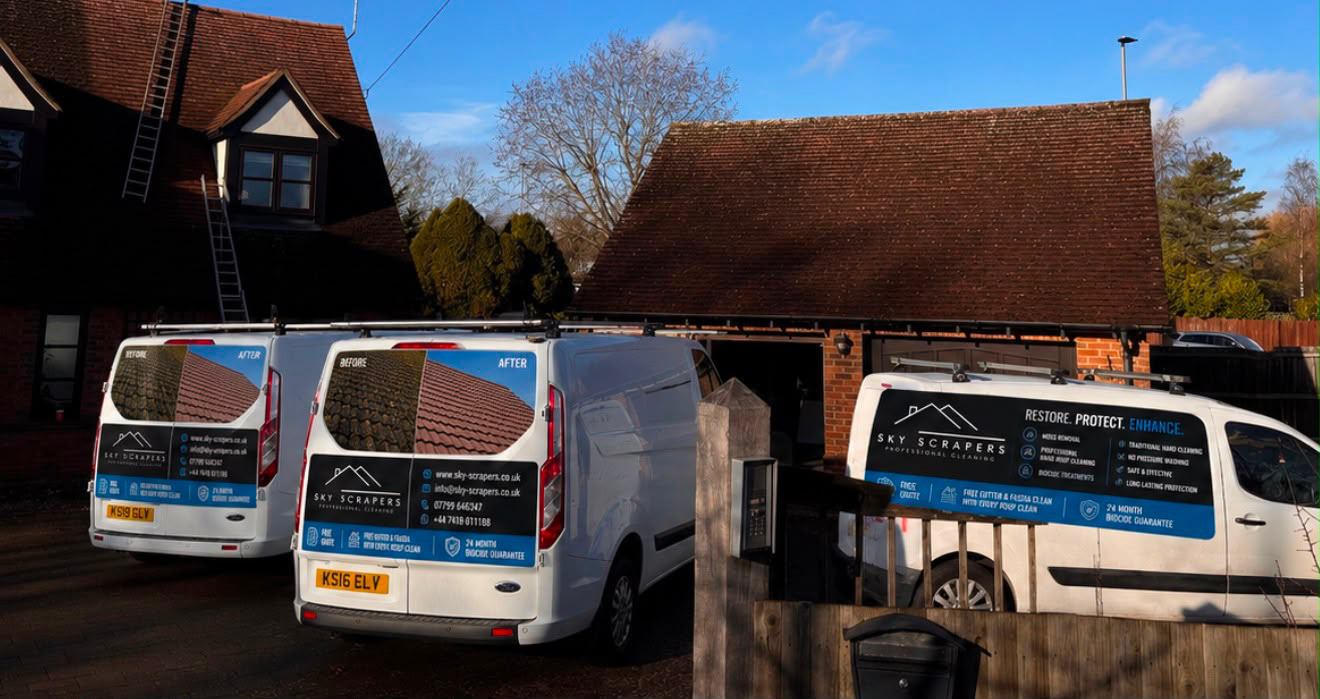
Our team is uniformed, fully insured and arrives in signwritten vans, which matters on sites where visitors and staff need to know who is on the premises.
Planned maintenance rather than reaction
Most commercial clients move to a scheduled arrangement after the first visit, typically annual or twice-yearly gutter clearing with roof and cladding cleaning at longer intervals. Scheduling is cheaper than emergency work and far cheaper than a water ingress claim.
We are happy to quote per visit or on a planned cycle across multiple properties, which suits agents and property managers looking after a portfolio.
Our own photographs
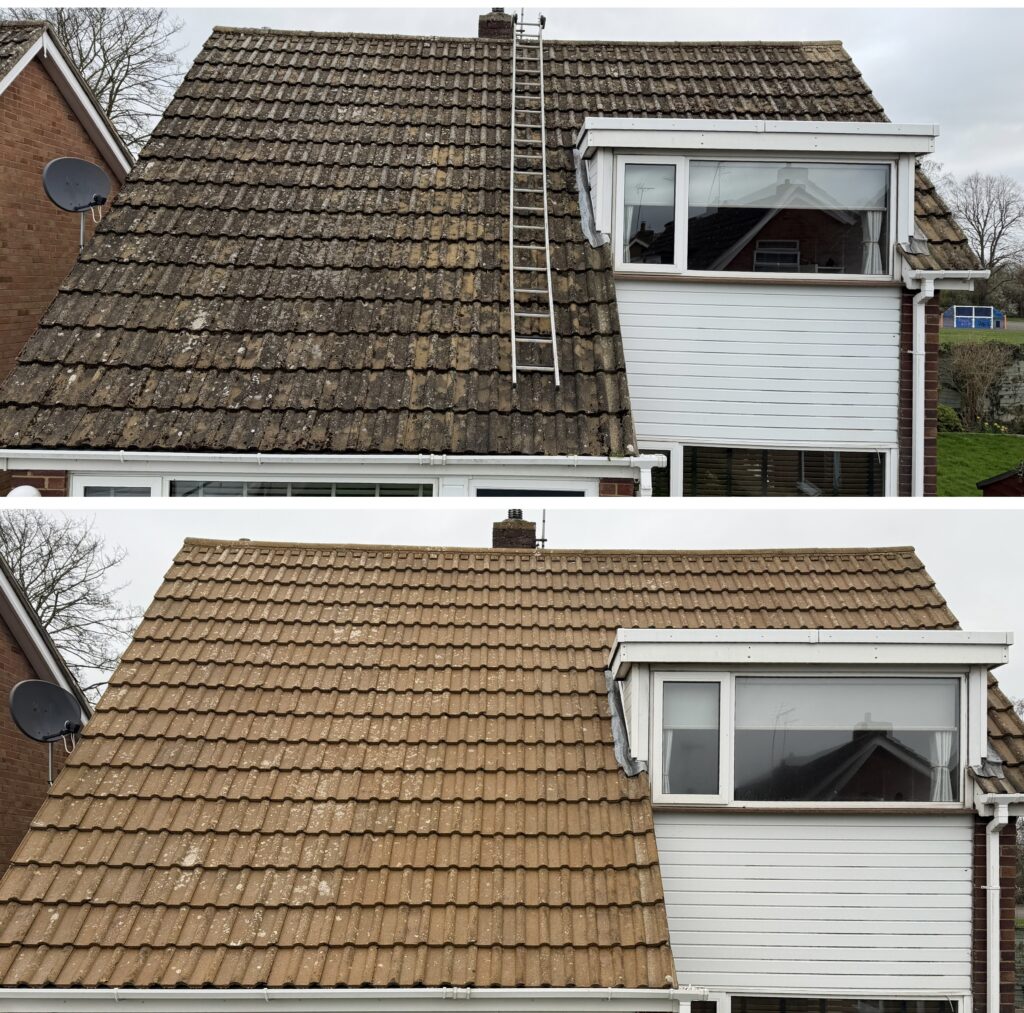
Images from Sky Scrapers Ltd work showing the methods described on this page.
Where this applies locally
Towns where this comes up most often on our patch:
- Hand Roof Cleaning in LutonBedfordshire · LU1
- Hand Roof Cleaning in BedfordBedfordshire · MK40
- Hand Roof Cleaning in Milton KeynesBuckinghamshire · MK1
- Commercial roof, gutter and cladding cleaningFor commercial premises
- Scheduled roof and gutter maintenance for managing agentsFor managing agents
- Fragile roof coverings and how they are worked safelySafety
Want a professional to handle it?
Talk to us about your premises
Free site survey, full documentation and work planned around your operating hours.
Sky Scrapers Ltd · info@sky-scrapers.co.uk
Questions we get asked
Can you work outside business hours?
Yes, where the site requires it. Early starts, weekend work and phased access are all workable and are agreed at survey stage.
Do you provide risk assessments and method statements?
Yes. Documentation, insurance evidence and photographic records of the work are provided as standard on commercial jobs.
Do you handle multiple sites for property managers?
We do. Portfolio work can be quoted per property and scheduled on a planned cycle so budgeting is predictable.
Is pressure washing used on commercial cladding?
No. Coated metal panels and render are soft washed, because pressure removes the protective coating and shortens the life of the panel.
How often should commercial gutters be cleared?
Annually as a minimum, and twice a year on sites with significant tree cover or a history of overflow. Internal box and valley gutters justify the shorter interval.
In short
Commercial roof work is planned around people, fragile surfaces and drainage rather than appearance alone. Get the survey right, prioritise gutters, soft wash coated surfaces, and move to a planned cycle rather than reacting to leaks.
Related services
Covering Bedfordshire and surrounding counties